


TL;DR:
- Preparing a clean data room and understanding consent and recapture triggers are key steps before selling energy assets.
- Options include operator buybacks, secondary-market sales, or strategic sales, each with different timelines and benefits.
The fastest, lowest-friction exits for private U.S. energy interests are operator buybacks, direct assignment to another investor, secondary-market sales through a broker, and recapitalization structures that provide partial liquidity. Your single most important first step: pull your data room and confirm consent triggers before you contact a single buyer. Delay costs you more than most sellers expect, because buyer diligence friction and stale marketing cycles erode offers fast.
Quick reference before you start:
- Operator buyback or assignment: a few weeks to a few months if consent is clean; fastest route when the operator has liquidity
- Secondary-market or brokered sale: several months; broader buyer pool, variable pricing
- Recapitalization or partial buyout: several months; preserves upside, requires negotiation
- Strategic sale to a fund or utility: many months to over a year; highest potential multiple, slowest process
Tax triggers to flag immediately:
- ITC or PTC recapture risk if you exit before the five-year in-service threshold
- IDC and depreciation recapture, which can convert capital gains to ordinary income
- K-1 timing: the year the sale closes determines your taxable year, so timing matters
Call your CPA and oil and gas attorney first. Pull your most recent K-1s, operating agreement, production records, and reserve report before any buyer conversation.
Table of Contents
- How to exit energy investments: five immediate steps
- What are your actual exit options?
- How buyers value your private energy interest
- Tax, reporting, and accounting issues to resolve before you sell
- Legal and closing mechanics: what can derail your deal
- How to make your interest more saleable before you go to market
- Where to find buyers and how to market your interest
- Should you sell now, hold, or take partial liquidity?
- Key Takeaways
- The exit discipline most sellers skip
- Fieldvest helps accredited investors plan and execute exits
How to exit energy investments: five immediate steps
-
Organize your documents. Gather K-1s, tax-basis schedules, IDC and depreciation schedules, the operating agreement (especially assignment and transfer clauses), title opinions, leases, reserve or engineering reports, production history, and LOE schedules. A clean, complete data room materially speeds buyer diligence and raises offers.
-
Confirm contractual transfer rules. Read every ROFR, operator consent provision, and change-of-control clause in your operating agreement and any PPA or interconnection agreement. Note notice deadlines. Missing a consent window can kill a deal or force a price cut.
-
Run a tax pre-check with your CPA. Confirm whether you are inside a credit recapture window, model capital gains versus ordinary income under different deal structures, and map your passive-loss carryforwards. Do this before you set a price.
-
Engage counsel and a valuation specialist. An independent reserve report or appraiser gives you a defensible number. Brief your advisor on timeline and confidentiality protocol, and get NDAs ready before any data-room access.
-
Prepare a seller packet. A one-page deal memo, 12-month production trend, and capex plan give early buyers enough to qualify interest without exposing sensitive data.
Pro Tip: Open a controlled data room now and run a short mock diligence call with your advisor. You will surface the top three deal-breaker items within 30 days, before a real buyer finds them.
What are your actual exit options?
Each route fits a different asset profile and investor objective.
-
Assignment or transfer to another investor. Fast when title is clear and consent is straightforward. Watch for transfer fees and operator consent timing. Best for operational interests with clean documentation.
-
Operator buyback. The operator already knows the asset, so diligence is minimal. Strategic operators may pay a premium for integration synergies. Check ROFR provisions first and confirm the operator has liquidity.
-
Secondary-market or brokered sale. Broader buyer access and competitive pricing, but quality of documentation drives the spread. Well-packaged, production-stable interests attract the best bids. With large volumes of projects for sale and limited buyer capacity, targeted outreach consistently outperforms broad auctions.
-
Recapitalization or partial liquidity. Sell a portion of your interest while retaining upside. Requires negotiation on management rights and fee structures, but preserves long-term cashflow participation.
-
Strategic sale to an infrastructure fund or utility. Often the highest multiple for scaleable assets with contracted cashflows, but buyer diligence is rigorous and timelines run long. Building exit optionality into your project financials from the start improves your negotiating position here.
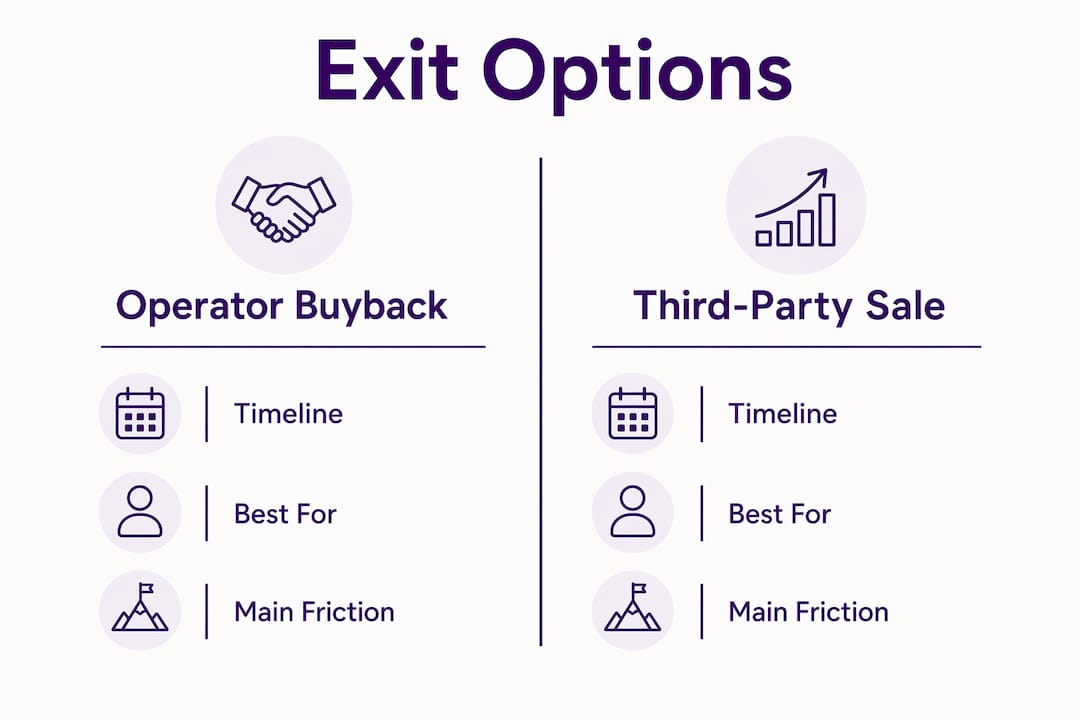
| Route | Typical timeline | Best for | Main friction |
|---|---|---|---|
| Operator buyback | a few weeks to a few months | Operational interests | ROFR, operator liquidity |
| Assignment/transfer | a few weeks to a few months | Clean title, consented | Consent timing, transfer fees |
| Secondary/brokered sale | several months | Production-stable assets | Data quality, buyer bandwidth |
| Recapitalization | several months | Growth-stage, partial cash need | Management negotiation |
| Strategic/fund sale | many months to over a year | Scaleable, contracted cashflows | Diligence depth, consent |
How buyers value your private energy interest
Buyers start with contracted cashflow quality. A PPA with a creditworthy offtaker commands a lower discount rate than merchant revenue; the contracted period versus the merchant tail is the first thing a sophisticated buyer models. They run a P50 baseline and stress-test with P75 and P90 sensitivities.
Beyond cashflow, buyers audit:
- Reserve base and decline curves. Verified production history with consistent LOE trends signals lower operational risk.
- Title clarity. Unresolved title gaps or encumbrances on leaseholds are among the most common reasons bids come in low.
- O&M reliability. Buyers look for SCADA or historian data, clean OT/IT integration, and measurable automation pilots with quantified ROI. Systematic gaps in operational data can leave 15–25% of valuation on the table.
- Financial controls. Fragmented reporting, unreconciled tax-basis schedules, and weak QoE documentation all reduce bids.
Pre-marketing valuation checklist: audited production records, independent reserve report, clear title opinion, reconciled tax-basis schedule, and a QoE or quality-of-service summary. Quantify any EBITDA lift potential from near-term operational improvements and include it in your marketing packet.
Tax, reporting, and accounting issues to resolve before you sell
Tax surprises are the most common source of post-signing regret for energy sellers. Three risks dominate.
- ITC and PTC recapture. Exiting before the five-year in-service threshold can trigger full credit recapture. Verify your holding period before you set a price or sign anything.
- IDC and depreciation recapture. Prior deductions taken as ordinary losses can convert sale proceeds from capital gains to ordinary income, depending on deal structure. An asset sale and a membership interest sale produce different outcomes. Your tax-efficient income strategy going in shapes what you owe on the way out.
- K-1 timing. The taxable year of the sale is determined by closing date. A December close versus a January close can shift a significant tax liability by a full year.
Required documents: recent K-1s, tax-basis schedules, accumulated IDC and depletion records, depreciation schedules, and prior-year tax elections. Get a pre-exit tax memo from a CPA experienced in energy tax, modeling after-tax proceeds under at least two deal structures.
Pro Tip: Simulate post-exit cashflow under three scenarios: immediate sale, staged earnout, and recapitalization. The structure that minimizes after-tax leakage is rarely the most obvious one.
Legal and closing mechanics: what can derail your deal
The standard workflow runs: NDA, teaser, data-room access, LOI, diligence, definitive agreement (assignment or purchase agreement), closing with escrow instructions, and post-closing adjustments. Each step has a common failure point.
- ROFR and ROFO clauses. Operators or co-investors may have the right to match any offer. Triggering ROFR without a plan adds weeks and can chill buyer interest.
- Change-of-control language in PPAs and interconnection agreements. Missing consent or notice provisions in these agreements can delay or derail a sale entirely.
- Equipment liens and UCC searches. Unresolved liens surface in diligence and force price adjustments or deal restructuring.
- Ambiguous assignment language. Vague transfer provisions in the operating agreement create negotiating leverage for buyers, not sellers.
- Environmental liabilities. Contingent third-party obligations or unresolved site issues are red flags that sophisticated buyers price aggressively.
Closing checklist: required vendor consents, updated title opinions, current insurance certificates, tax clearance where applicable, and agreed escrow and indemnity structures. Run targeted contract red-team reviews at least 90 days before marketing.
How to make your interest more saleable before you go to market
Buyers audit five operational pillars: technology and data infrastructure, operational data maturity, AI and automation readiness, security and compliance, and team depth. Gaps in any of these areas compress multiples.

Data-room essentials: organized production history, SCADA or OT summaries, reserve report, title opinion, audited financials or QoE, and permits and compliance records.
Quick high-impact fixes:
- Resolve title gaps before marketing, not during diligence
- Standardize production reporting cadence so trends are readable at a glance
- Run an external reserve or engineering check to validate your internal numbers
- Shore up basic financial controls and reconcile your tax-basis schedule
Pro Tip: Deploy one measurable operational pilot, such as a BI dashboard or O&M efficiency project, that you can present with quantified ROI in the marketing packet. Buyers pay for demonstrated improvement, not potential.
An 18-month exit-readiness program works in three phases: quick wins and data cleanup in months 1–6, compliance and audit tasks in months 6–12, and mock diligence with banker engagement in months 12–18.
Where to find buyers and how to market your interest
Operator buybacks move fastest but rarely produce the highest price. Curated direct outreach to funds and strategics takes longer but often yields better multiples for well-documented assets. Brokers and secondary marketplaces provide buyer access and process discipline at the cost of a fee and some confidentiality.
Marketing packet template:
- One-page teaser (no sensitive data)
- 5–7 page investment memorandum
- Three-year production and financial model with P50, P75, and P90 sensitivities
- Reserve report summary
- Data-room index
| Channel | Speed | Price potential | Best for |
|---|---|---|---|
| Operator buyback | Fast | Moderate | Operational, consented interests |
| Direct fund/strategic outreach | Moderate | High | Scaleable, contracted assets |
| Broker/secondary marketplace | Moderate | Variable | Production-stable, documented |
| Private buyer direct | Variable | Variable | Smaller interests, known network |
Early advisor engagement reduces time-to-close and avoids stale marketing cycles. Limit conflicts, stage information release, and use NDAs before any data-room access.
Should you sell now, hold, or take partial liquidity?
Run this decision flow before committing to a path.
- Evaluate the market window. Is buyer demand strong? Are interest rates compressing multiples? Divesting from energy assets during an oil or energy price rally can mean leaving money on the table if you exit public positions simultaneously.
- Assess asset de-risking. Is your PPA signed? Interconnection secured? Reserves verified? Each milestone adds valuation.
- Check the tax calendar. K-1 timing and recapture windows can make a 90-day timing difference worth significant dollars.
- Map personal liquidity needs. Portfolio concentration and income requirements are legitimate inputs, not afterthoughts.
Signals that favor selling now: binding offers near your target, a buyer with bandwidth and consent already addressed, or unresolved consent risk that will only grow more complex.
Signals that favor holding: expected near-term contract improvements, policy tailwinds that will lift multiples, or a recapitalization offer that preserves meaningful upside.
Pro Tip: Model three scenarios: immediate sale, 12-month hold, and recapitalization. Stress-test each against a 20% oil price decline and a 150-basis-point rate increase. The scenario that survives both stress tests is usually the right answer.
Partial liquidity works best when growth optionality remains but you need current cash. Recap terms that preserve your upside participation are worth negotiating hard for.
Key Takeaways
Exiting a private U.S. energy investment without tax leakage requires assembling a clean data room, confirming consent and recapture triggers, and engaging a CPA and oil and gas attorney before any buyer conversation.
| Point | Details |
|---|---|
| Assemble the data room first | Pull K-1s, title opinions, reserve reports, and production records before contacting any buyer. |
| Confirm consent and recapture triggers | Check ROFR, operator consent, and ITC/PTC five-year holding periods before setting a price. |
| Quantify valuation levers | Contracted cashflow quality, title clarity, and operational data maturity are the top price drivers. |
| Target buyers, don’t broadcast | Curated outreach to qualified buyers with bandwidth outperforms broad auctions in a supply-heavy market. |
| Fieldvest for vetted deal access | Fieldvest connects accredited investors with vetted U.S. energy projects and supports pre-exit tax planning and advisor referrals. |
The exit discipline most sellers skip
Most sellers treat exit planning as a final-year task. That is the single most expensive mistake in private energy investing. By the time a buyer’s diligence team finds a title gap, a missing consent, or a fragmented production history, you have already lost negotiating leverage. The fix is not complicated; it just requires doing the work 12–18 months earlier than feels necessary.
The tax angle is where I see the sharpest value leakage. Sellers who close in December without modeling the K-1 timing impact, or who exit a tax-equity position inside the five-year recapture window without a pre-exit tax memo, routinely give back a material portion of their proceeds to the IRS. That is avoidable with one conversation with the right CPA before you sign anything.
The other underestimated factor is buyer bandwidth. The market for private energy interests is not illiquid, but it is bandwidth-constrained. A well-packaged asset with a clean data room and a targeted buyer list closes faster and at a better price than a broadly marketed one. Precision beats volume every time in this market.
Fieldvest helps accredited investors plan and execute exits
When you are ready to think through your exit, Fieldvest gives you a head start. The platform provides access to vetted U.S. energy deals with transparent investment documentation from day one, which means your data room is cleaner when the time comes to sell. Fieldvest also connects accredited investors with tax resources and advisor referrals specifically for oil and gas tax planning, including pre-exit reviews that model after-tax proceeds before you commit to a structure.
Three ways Fieldvest supports your exit process: organized deal documentation that feeds directly into a data room, introductions to CPAs and oil and gas attorneys experienced in energy tax, and a platform built around the transparency accredited investors need to make confident decisions. Use the tax deduction calculator to model your first-year deductions and post-exit tax scenarios, then request a pre-exit review to map the path forward.
Recommended

Get the Fieldvest Energy Brief
and AI-driven demand shifts — curated for accredited investors. Smart. Strategic. Tax-advantaged.