


TL;DR:
- Oil and gas investments offer high tax deductions and income potential but involve significant risks and illiquidity.
- Careful operator selection, long-term commitment, and understanding structure are crucial for success in this asset class.
What you need to know about oil and gas investments before committing capital
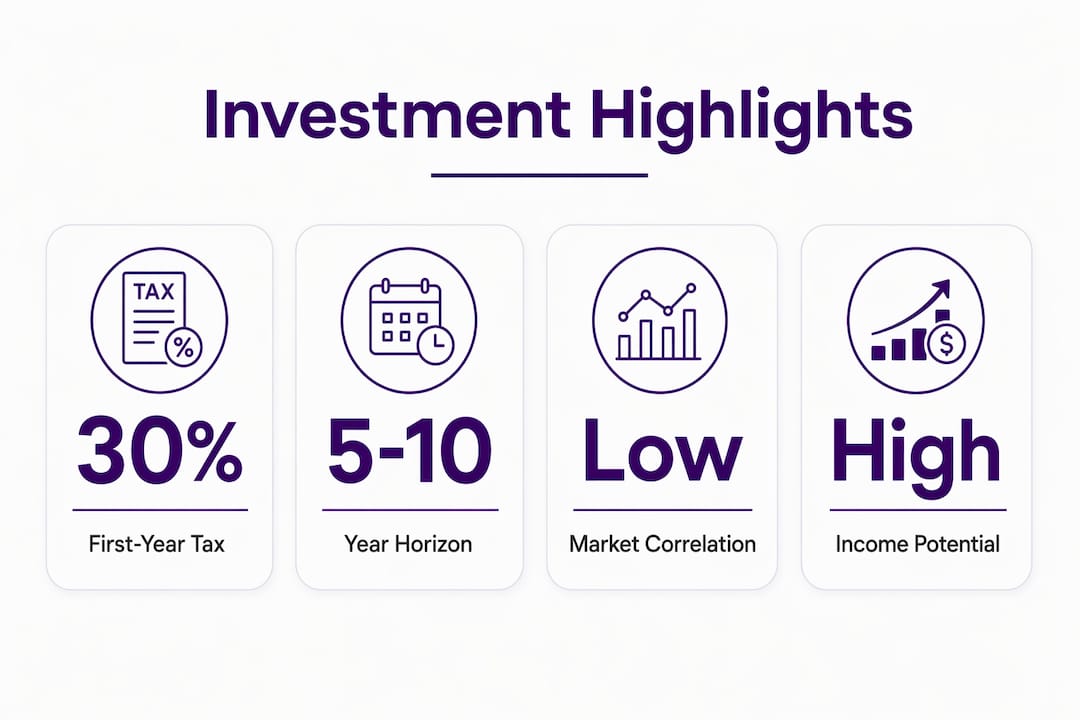
Oil and gas investments offer accredited U.S. investors three things most asset classes cannot combine: large first-year tax deductions, income potential from producing wells, and returns that tend to move independently of the stock market. The tradeoff is real. These are illiquid, high-risk positions where losing your entire investment is a genuine possibility, not a boilerplate warning.
To access private oil and gas offerings at all, you need to qualify as an accredited investor under SEC Regulation D Rule 506, which sets income and net worth thresholds specifically because of the elevated risks and limited liquidity involved in private placements.
The core benefits at a glance:
- Large first-year deductions through intangible drilling costs (IDCs) and depletion allowances
- Income streams from producing wells that can last years or decades
- Portfolio diversification through assets with low correlation to equities and bonds
- Potential for high returns in favorable commodity price environments
The core risks you must accept:
- Illiquidity: most positions have no secondary market and require indefinite hold periods
- Capital loss: dry holes and failed projects can wipe out the full investment
- Commodity price volatility: oil and gas prices swing sharply on geopolitical and supply events
- Fraud exposure: SEC fraud cases involving private oil and gas offerings have averaged more than 20 per year since 2007, up from just a handful in 2005 and 2006
The investors who do well in this space treat it as a long-term allocation, not a trade. They pick operators carefully, understand the tax mechanics before writing a check, and never put in more than they can afford to hold indefinitely.
Tax benefits and incentives that make oil and gas investing uniquely attractive
The tax treatment of U.S. oil and gas investments is unlike almost any other asset class. Congress has deliberately structured the tax code to encourage domestic energy production, and the result is a set of deductions that can dramatically reduce your taxable income in the year you invest.
Intangible drilling costs (IDCs)
IDCs cover the non-salvageable expenses of drilling a well: labor, chemicals, mud, grease, and other items that have no physical value after the well is drilled. These costs typically represent 65%–80% of total drilling costs, and the IRS allows investors in working interests to deduct them in full in the year they are incurred. For a high-income investor in the top federal bracket, that deduction can offset a large portion of the initial capital outlay in year one. You can explore how this plays out for your specific tax situation with Fieldvest’s oil and gas tax calculator.
Depletion allowances
Once a well is producing, investors can deduct a percentage of gross income from the well each year through the depletion allowance. The percentage depletion method allows independent producers and royalty owners to deduct a set percentage of gross revenue, regardless of the actual cost basis of the property. This deduction continues year after year as long as the well produces, making it a recurring tax benefit rather than a one-time event.
How these deductions work in practice
Consider an accredited investor who commits $200,000 to a working interest in a drilling program. If 70% of that capital goes toward IDCs, the investor may be able to deduct $140,000 against ordinary income in year one, before the well produces a single barrel. That kind of front-loaded deduction is what draws high-earning professionals to tax-efficient energy investments in the first place.
Common misconceptions to clear up:
- IDC deductions apply to working interests, not passive royalty interests in most cases
- The alternative minimum tax (AMT) can limit IDC deductions for some investors; consult a tax advisor
- Depletion allowances are not the same as depreciation; they are specific to natural resource extraction
- These benefits are legal and explicitly written into the U.S. tax code, not loopholes
IRS and SEC compliance matters here. The structure of the offering determines whether you qualify for these deductions, and promoters sometimes misrepresent how the tax benefits apply. Always have a qualified tax attorney or CPA review the private placement memorandum before investing.
| Point | Details |
|---|---|
| IDC deductions | Working interest investors can deduct most drilling costs in year one, reducing taxable income immediately. |
| Depletion allowances | Independent producers deduct a set percentage of gross well revenue annually for the life of production. |
| AMT exposure | Some investors face AMT limitations on IDC deductions; verify with a CPA before committing capital. |
| Structure matters | Only certain investment structures qualify for these deductions; passive interests often do not. |
How oil and gas can strengthen your portfolio’s returns and diversification
The case for including energy in a diversified portfolio goes beyond the tax angle. Oil and gas assets have historically generated returns that do not track closely with equities or fixed income, which means they can reduce overall portfolio volatility while adding an income component.
Return profiles and historical volatility
Oil and gas investments span a wide range of risk and return profiles depending on the structure. Producing wells with established cash flow carry lower risk than exploratory drilling programs, which can generate outsized returns or total losses. Working interests in development wells, where the geology is better understood, tend to sit in the middle of that spectrum.
The volatility is real. Commodity prices move on OPEC decisions, geopolitical events, and macroeconomic shifts, sometimes sharply within a single quarter. Investors who entered the sector in 2020 during the COVID-19 demand collapse faced severe paper losses before prices recovered. That cycle is a useful reminder that the income potential is genuine, but so is the downside.
Types of oil and gas investment opportunities
Understanding the structure of your investment determines both your risk exposure and your tax treatment:
- Working interest: You own a share of the well and bear a proportionate share of drilling and operating costs. This structure qualifies for IDC deductions and depletion allowances, but it also exposes you to cost overruns and dry holes.
- Royalty interest: You receive a percentage of production revenue without bearing operating costs. Lower risk than a working interest, but typically no IDC deduction eligibility.
- Mineral rights: Ownership of the subsurface resource itself, which can generate royalty income from multiple operators over time. These can be bought, sold, or leased independently of surface rights.
- Non-operating working interest: You participate in drilling economics without managing operations. Returns depend heavily on the operator’s execution.
- Private equity funds: Institutional vehicles like the oversubscribed $1.277 billion fund closed by Silver Hill Energy Partners in 2026 pool capital across multiple assets and basins, spreading risk while targeting operated positions.
Diversification benefits
Oil and gas returns tend to correlate with energy prices rather than equity market cycles. During periods of equity market stress driven by interest rate concerns or credit events, energy assets often hold their value or appreciate if commodity prices remain firm. That low correlation is the diversification argument in a single sentence. For investors already concentrated in equities, real estate, or fixed income, a well-structured energy allocation can smooth out the portfolio’s overall return profile. Fieldvest’s resources on long-term energy income cover how producing well income compounds over time within a broader wealth strategy.
What the current market environment means for your risk exposure
The oil and gas sector in 2026 operates under a different set of pressures than it did a decade ago. Understanding those structural changes is not optional for anyone putting serious capital to work here.
Capital discipline has replaced growth-at-any-cost
The shale revolution’s early years were defined by aggressive drilling funded by cheap debt and growth-focused investors. That era is over. Producers now prioritize cost discipline and sustainable returns over rapid expansion, which means drilling activity responds more slowly to price increases than it once did. The U.S. rig count sat at its lowest level since 2022 as of mid-2026, and producers indicated they need to see durably higher prices before resuming significant drilling activity.
This shift has two implications for investors. First, capital-disciplined operators are generally better partners: they are less likely to drill marginal wells just to deploy your money. Second, the supply response to higher prices is slower, which can extend favorable pricing environments when they occur.
Supply investment gaps and price volatility
An analysis by the International Energy Forum in partnership with BCG found that upstream investment needed to rise by at least 25% annually from 2020 levels through the mid-2020s to prevent supply shortfalls and market instability. Underinvestment at the industry level tends to tighten supply, which eventually pushes prices higher. But the path from underinvestment to higher prices runs through a period of uncertainty and volatility that can hurt investors with short time horizons.
Statistic callout: The IEF and BCG analysis projected that without sufficient upstream investment, intra-annual oil price ranges could widen significantly, increasing boom-and-bust cycle risk for investors across the sector.
Geopolitical and regulatory pressures
OPEC+ production decisions, U.S. trade policy uncertainty, and stricter regulatory requirements for new upstream infrastructure all affect the investment calculus. The Morningstar analysis noted that OPEC+ accelerating crude production in 2026 was pressuring WTI prices toward the low $60s, while geopolitical tensions in the Middle East created potential upside scenarios. Neither outcome is predictable with confidence.
Regulatory pressure on carbon emissions is also increasing the cost of new upstream development in some jurisdictions, though U.S. onshore shale basins remain among the most accessible and cost-competitive environments globally.
Pro Tip: Investors with a 5–10 year time horizon tend to navigate boom-and-bust cycles far better than those expecting returns within 18 months. Partnering with operators who have demonstrated capital discipline across multiple price cycles is the single most effective way to reduce structural risk in this asset class.
How to evaluate oil and gas investment structures and avoid costly mistakes
Private oil and gas offerings are where most individual investors encounter this asset class, and they are also where most fraud occurs. The SEC has been explicit: the number of fraud cases involving private oil and gas offerings averaged more than 20 per year since 2007. Knowing how these structures work and what questions to ask is not optional due diligence. It is the price of admission.
Common investment structures
Private placement memorandums (PPMs): Most private oil and gas offerings come packaged as a PPM, which outlines the venture’s management, drilling plans, investment terms, and financial statements. If you are not given anything in writing, treat that as a disqualifying red flag immediately.
Working interest partnerships: Investors pool capital to fund drilling operations and share proportionately in production revenue and costs. The operator manages the well; investors participate economically.
Non-operating interests: You participate in the economics of a well without taking on operational responsibilities. Returns depend entirely on the operator’s competence and honesty.
Direct participation programs (DPPs): Structured vehicles that pass through income and deductions directly to investors, often used specifically to deliver the IDC and depletion deductions described earlier.
Your due diligence checklist
The SEC’s investor alert on oil and gas offerings provides a clear framework for evaluating any private offering. Work through every item before committing capital:
- Use of proceeds: Ask exactly how your money will be spent. Get a breakdown between drilling operations, administrative overhead, and broker sales fees. A promoter who cannot answer this question in writing has no business taking your capital.
- Related parties: Find out whether the promoter owns the drilling company or has financial relationships with vendors being paid from your investment. Front-end loads hidden in PPMs inflate drilling costs and enrich promoters before a single barrel is produced.
- Prior experience: Verify the operator’s track record independently. Ask for references and check them. Promoters have been known to fabricate experience to discourage questions.
- Well history: If the area has been drilled before, find out what was produced and why this attempt will be different. New drilling technologies like hydraulic fracturing and horizontal drilling have unlocked previously uneconomic formations, but they require specialized expertise and carry higher costs.
- Third-party engineering report: Ask whether an independent engineer or geologist evaluated the site. If the promoter claims a report exists but will not show it to you, walk away.
- Reserve classifications: Understand whether the offering discusses proved, probable, or possible reserves. Proved reserves are relatively certain. Probable and possible reserves carry a 50%–10% probability of extracting the estimated amount, respectively. The word “reserves” sounds certain; it rarely is.
- Broker due diligence report: The SEC recommends that investors always request a copy of the broker’s due diligence report when considering any private oil and gas offering. A registered broker cannot simply rely on the promoter’s claims; they must independently verify them.
You can also verify a broker’s registration and disciplinary history through FINRA BrokerCheck before engaging with any intermediary.
Pro Tip: Ask the operator directly how much of their own capital is invested in this specific project. A promoter whose compensation comes entirely from fees rather than well performance has no financial reason to care whether the well succeeds. Operators with meaningful capital at risk alongside investors are structurally better aligned with your interests.
How to identify trusted oil and gas operators worth investing with
Selecting the right operator is the single most consequential decision in oil and gas investing. The geology, the tax structure, and the commodity price environment all matter, but a bad operator can destroy value in any of those conditions. A good one can generate returns even in a difficult market.
What experienced, capital-disciplined operators look like
The best operators in U.S. onshore basins share a few observable characteristics. They have a track record of completed projects across multiple price cycles, not just the easy years. They operate in basins where they have genuine geological expertise, not wherever capital is available. They maintain transparency with investors about costs, production rates, and project timelines. And they have their own capital at risk in the projects they manage.

The institutional market reflects this preference. Silver Hill Energy Partners’ fifth fund closed oversubscribed at $1.277 billion in 2026, with the majority of capital coming from repeat investors, including endowments, pension funds, and family offices. That repeat investor base is a meaningful signal: sophisticated institutional capital tends not to return to operators who have disappointed them.
Transparency and track record verification
Before investing with any operator, request audited financial statements from prior projects, production histories for completed wells, and references from other investors in previous programs. Cross-reference any reserve estimates against independent third-party audits. The IEF’s analysis of oil and gas investment risks is direct on this point: long-term partnerships with proven operators are the most reliable way to reduce the structural and cyclical risks inherent in this sector.
How Fieldvest approaches operator selection
Fieldvest connects accredited investors with vetted U.S. energy operators who offer large first-year tax deductions and long-term production income. The platform focuses on operators with demonstrated capital discipline, transparent reporting, and meaningful skin in the game. For investors who want to understand how tax deductions translate into after-tax returns before committing, Fieldvest’s guide on lowering taxes with oil and gas walks through the mechanics in plain language.
Pro Tip: Request an independent third-party engineering assessment for any project before investing, and ask whether the operator has used the same engineering firm repeatedly. An engineer who depends on repeat business from the promoter is not truly independent. Ongoing production monitoring reports from a neutral third party are equally important after you invest.
Exit strategies and liquidity: what investors rarely ask about until it’s too late
Liquidity is the most underestimated risk in private oil and gas investing. Most investors focus on the upside scenario and the tax benefits, then discover mid-investment that their capital is effectively locked up with no clear exit path.
The liquidity reality of private oil and gas positions
Private oil and gas investments are generally illiquid. There is no exchange where you can sell your working interest or partnership unit on a Tuesday afternoon. Secondary markets for these positions exist but are thin, and selling at anything close to fair value requires finding a buyer who understands the asset and has capital available. In practice, most investors hold their positions until the well’s production declines to the point where the operator winds down the program or until a formal liquidity event occurs.
Hold periods vary by structure and project type. Development drilling programs in established basins may return capital within three to seven years if production is strong. Exploratory programs carry longer and less predictable timelines. Royalty interests and mineral rights can generate income indefinitely but may not return principal unless sold.
Planned exit structures
Some private oil and gas programs include defined exit mechanisms. These might include:
- Asset sale: The operator sells the producing properties to a larger company or a private equity buyer, distributing proceeds to investors. This is the most common exit for institutional-style programs.
- Rollup or merger: Smaller programs are consolidated into a larger entity that may eventually seek a public listing or a strategic sale.
- Production run-off: Investors simply receive their share of production revenue until the well depletes, with no formal exit event. This suits investors who want ongoing income rather than a capital return.
- Secondary market sale: Selling your interest to another accredited investor through a broker or private transaction. Pricing is negotiated and often reflects a discount to the position’s theoretical value.
Matching liquidity needs to investment structure
The practical implication is straightforward: never commit capital to a private oil and gas program that you might need within five years. If your financial plan requires liquidity within that window, a different asset class is the right choice. For investors with a longer horizon and genuine income needs, high-yield energy investment examples illustrate how producing well income can serve as a durable cash flow source while capital remains deployed.
The investors who get into trouble are not those who understood the liquidity constraints and accepted them. They are the ones who did not ask the question until they needed the money.
Key Takeaways
Oil and gas investments deliver their strongest results for accredited investors who combine tax-efficient structures with capital-disciplined operators and a long-term hold commitment.
| Point | Details |
|---|---|
| Tax deductions are front-loaded | IDC deductions can offset a large portion of year-one capital against ordinary income for working interest investors. |
| Illiquidity is structural | Most private oil and gas positions have no secondary market; plan for hold periods of three to seven years or longer. |
| Operator selection drives outcomes | Operators with capital at risk and audited track records across multiple price cycles reduce structural investment risk. |
| Fraud risk is documented | SEC fraud cases in private oil and gas offerings averaged more than 20 per year since 2007; always request the broker’s due diligence report. |
| Capital discipline shapes the market | Producers now prioritize efficient returns over growth, which affects drilling activity and the timing of supply responses to price changes. |
Fieldvest connects you with vetted U.S. energy projects

Fieldvest is built for accredited investors who want the tax advantages and income potential of U.S. oil and gas without the guesswork of finding trustworthy operators on their own. Every project on the platform goes through a vetting process focused on operator track record, capital alignment, and transparency. Use the free tax deduction calculator to see what a first-year IDC deduction could mean for your specific tax situation, then explore current opportunities at fieldvest.com.
Recommended

Get the Fieldvest Energy Brief
and AI-driven demand shifts — curated for accredited investors. Smart. Strategic. Tax-advantaged.