


An oil and gas title opinion is a legal analysis that identifies who owns the minerals and leasehold interests in a tract, what burdens attach to that ownership, and what defects could threaten its marketability. We rely on these opinions to decide whether to drill, how to split revenue, and what to fix before closing a deal. Curative items flagged in an opinion can affect price, timing, or closing.
TL;DR:
- Choose an opinion by transaction stage: drilling opinions cover proposed units before operations, while division order opinions verify decimal payment shares after production begins.
- Confirm the caption and examined materials match the exact tract or unit; conclusions do not apply beyond the records and property included in the stated scope.
- Treat unleased owners, severed executive rights, and liens as distinct problems because they can block drilling, complicate lease negotiations, or delay proceeds until cured.
- A division order certifies payment shares but does not establish clean title or change lease terms, so it cannot replace a title opinion.
Table of Contents
- Types of Title Opinions and When to Order Each
- Core Components of a Title Opinion and How to Navigate the Report
- How U.S. Title Examinations Are Performed
- Interpreting Findings: What Title Issues Mean for Ownership and Risk
- Division Order Opinion vs. Title Opinion: Why Both Matter
- Checklist: What to Do After Receiving a Title Opinion
- Applying Title Opinions in Investor Diligence
- Reviewing Vetted Deals and Title Materials With Fieldvest
- FAQ
- Sources
Types of Title Opinions and When to Order Each
The opinion we order depends entirely on where we sit in the transaction.
A drilling title opinion is a comprehensive version, covering the tracts in a proposed unit before drilling. It can identify who must be leased, who holds executive rights, and whether gaps in the chain of title need to be cured before operations begin.
A division order title opinion may be prepared after a well is producing to calculate decimal interests for the pay deck. It confirms who gets paid and in what share, which is a narrower question than the drilling opinion answers.
An acquisition title opinion focuses on the seller’s interest in a specific transaction, checking marketability so a buyer knows exactly what they are purchasing and at what risk.
- Drilling opinion: pre-spud, unit-wide, identifies leasing and curative needs.
- Division order opinion: post-production, confirms decimal shares for payment.
- Acquisition opinion: deal-specific, verifies seller’s title before closing.
- Supplemental opinion: updates an existing opinion after new activity or curative work.
- Drill-site opinion: limited to the specific tract hosting the wellbore, used when speed matters more than full-unit coverage.
Core Components of a Title Opinion and How to Navigate the Report
Every well-constructed opinion follows a recognizable structure, and knowing where to look saves hours during due diligence, according to a practitioner guide on mineral title opinions.
- Caption and legal description: this section defines the exact tract covered and limits everything that follows. An opinion covering the wrong description is worthless no matter how thorough the analysis inside it.
- Materials examined: a list of the records actually reviewed, courthouse abstracts, prior opinions, affidavits, and what was deliberately excluded from scope.
- Individual tract ownership summary: a breakdown of surface, mineral, and leasehold ownership for each tract, usually the section readers go to first.
- Schedules: itemized lists of leases, mortgages, assignments, and other encumbrances affecting the tract, each tied back to its recording reference.
- Comments, exceptions, and requirements: the examiner’s professional judgment on defects, gaps, or risks, ranked by how urgently they need curative action before closing or drilling.
This structure exists because a title opinion reports the present state of title and gives the reader a roadmap for both the decision at hand and the curative work that follows, per the same practitioner guide.
How U.S. Title Examinations Are Performed
Examiners build an opinion from public records, and the method depends on what is available in a given county.
- Courthouse stand-up review: an examiner physically works through grantor-grantee indexes, still common in counties without digitized records.
- Digital abstracts and imaging: increasingly used where county systems have scanned deed books, mortgages, and probate files, speeding up the process without changing the standard applied.
- Key record sources: county clerk indexes, tax assessor rolls, probate court files, state oil and gas commission records, and, for federal minerals, the Bureau of Land Management, which oversees onshore federal leasing.
- Marketable title standard: examiners apply professional judgment against established norms, including the guidance behind Morgenthaler’s “Thirteen Rules,” which stress thoroughness and healthy skepticism, as discussed in academic analysis of title opinion practice.
Certified abstracts and supplemental materials strengthen confidence in an opinion, but no exam eliminates risk entirely. Format and sequencing vary by examiner and by client need, which is why reading the scope section first matters as much as reading the conclusion.
Interpreting Findings: What Title Issues Mean for Ownership and Risk
A title opinion’s real value shows up in what it flags as wrong, not what it confirms as clean.
- Unleased mineral owners mean a portion of the unit cannot legally produce until a lease is secured, delaying spud or shrinking the working interest available to drill.
- Severed executive rights can mean the person receiving royalty checks is not the one with authority to negotiate the lease, a distinction that changes who a landman needs to approach.
- Outstanding assignments or liens can cloud who is entitled to proceeds, sometimes requiring a release or payoff before funds can be disbursed.
- Decimal ownership and net revenue interest calculations, once confirmed, feed directly into the division order pay deck, determining exactly who gets paid and how much.
Common curative actions include affidavits of heirship, quiet title actions, and formal lien releases, usually handled by land staff or outside counsel rather than the examiner who wrote the opinion. These findings routinely shape pricing, escrow holdbacks, and closing conditions on acquisition deals, since a buyer rarely pays full price for an interest with unresolved curative items attached.
Division Order Opinion vs. Title Opinion: Why Both Matter
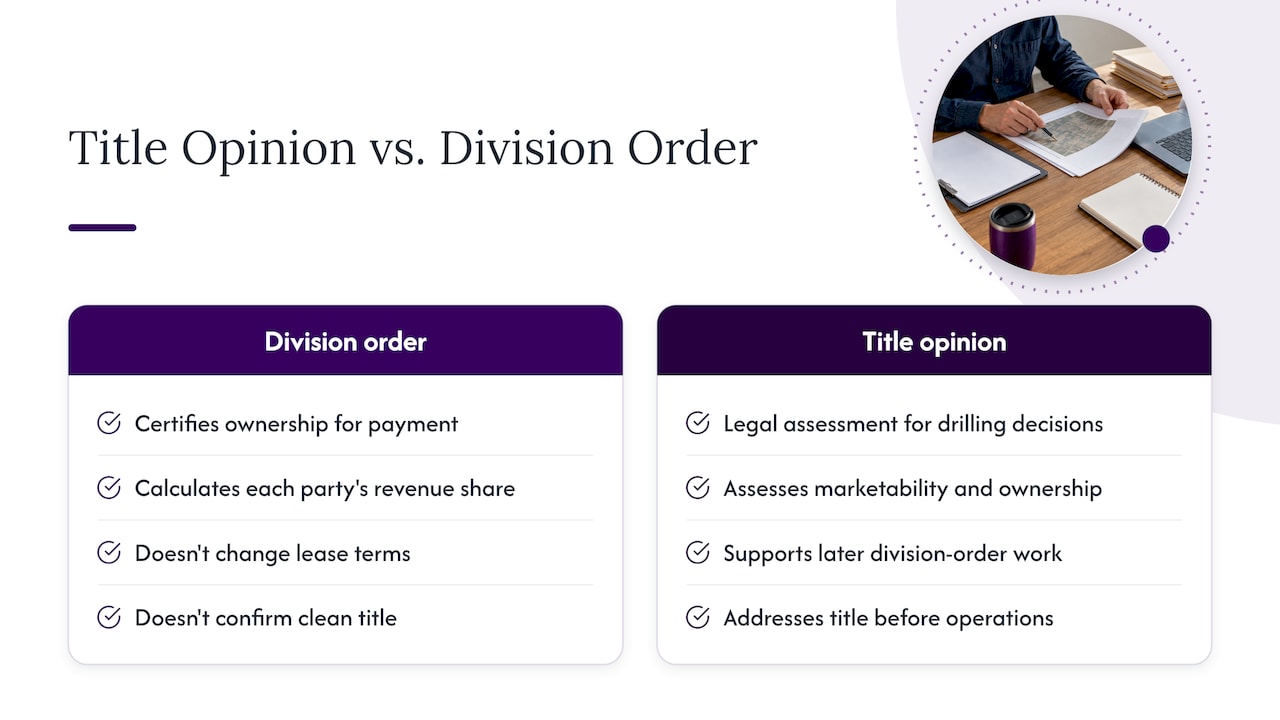
A division order is a payor’s tool used to certify ownership and calculate each party’s share of revenue. It may help protect the payor against paying the wrong party, but it does not change the underlying terms of a lease, and signing one is not the same as confirming clean title.
A title opinion is the legal assessment that supports both the drilling decision and the later division order. It can support the drilling decision and later division-order work: examiners assess marketability and ownership, and decimal interests may be revisited when production starts for the division order. Skipping the title opinion and relying on a division order alone leaves curative gaps unresolved.
Checklist: What to Do After Receiving a Title Opinion
Once an opinion lands on your desk, the work shifts from legal analysis to execution.
- Confirm scope first: verify the opinion’s caption and materials examined actually cover the exact tracts or unit you care about.
- Reconcile decimal shares: cross-check the ownership summary against internal accounting records before building a pay deck.
- Rank exceptions by urgency: separate items requiring curative before closing from those that can move to escrow or post-closing remedies.
- Coordinate across teams: route the opinion’s findings to legal, land, and division order staff so outputs convert cleanly into closing conditions.
- Request supplements when needed: ask for additional affidavits, updated abstracts, or a quiet title action if a defect is significant enough to threaten marketability.
Pro Tip: Treat each “requirement” in the comments section as an item to review, and confirm with your team whether it must be satisfied before closing.
These steps matter whether you are a landman preparing to spud or an investor evaluating an asset transfer.
Applying Title Opinions in Investor Diligence
Working through title opinions over the years taught me that they function less as legal paperwork and more as communication tools. The real value comes from using them to align land, legal, and accounting teams around the same facts and timelines.

The biggest mistake we see is treating the opinion’s scope section as boilerplate. If materials examined do not match the unit you are buying into, every conclusion after it is irrelevant to your deal.
When an opinion flags a material defect, insist on a clear curative timeline or an escrow holdback tied to it. Vague promises to “fix it later” rarely hold up once a deal closes.
— Sharif
Reviewing Vetted Deals and Title Materials With Fieldvest
We connect accredited investors with vetted U.S. energy projects and present key project materials to support due diligence. Instead of chasing scattered records across operators, we organize the core documents investors need to evaluate ownership and risk in one place.

- Review producing assets, development projects, and energy infrastructure deals for accredited investors.
- Access checklists and core deal documents that support your own diligence process.
- See how mineral rights ownership factors into tax-advantaged returns before committing capital.
Browse opportunities on Fieldvest and evaluate what fits your portfolio.
FAQ
Why would someone buy mineral rights?
Mineral rights are a real property interest that convey the right to explore for and produce oil and gas, and owners can collect royalties on production, which federal rules treat as ordinary income. Investors may buy them for potential income and tax considerations associated with ownership of a producing or development asset.
Who regulates oil and gas companies?
Oversight splits between state oil and gas commissions, which handle drilling permits and spacing, and the Bureau of Land Management, which manages leasing and related activities on federal lands under applicable laws. State and federal rules apply differently depending on whether the minerals in question are privately owned or federally managed.
How do I calculate royalty interest on oil and gas?
Royalty interest is calculated as a fraction of production revenue tied to your ownership share, confirmed through the decimal interest figures in a division order title opinion. Those decimal shares come directly from the tract ownership summary established during the title examination.
Are oil and gas rights considered real property?
Yes, mineral rights are treated as real property interests that can be sold, leased, or inherited separately from surface rights. This separation is why a title opinion must examine mineral and surface ownership independently when confirming who holds what interest.
Sources
- A Model Form Title Opinion: Time for a Revisit?
- The ABCs of the Mineral Title Opinons
- About Oil and Gas | Bureau of Land Management
Recommended

Get the Fieldvest Energy Brief
and AI-driven demand shifts — curated for accredited investors. Smart. Strategic. Tax-advantaged.